
The stock market continues to possess an uncanny ability to surprise. Through years of steady expansion and sudden pullbacks, investors have repeatedly dusted off the phrase, "How about that stock market?" When equity markets crash, anxiety naturally surges as retirement portfolios shrink. Yet, even when indices climb to historic valuations, a different kind of dread sets in—the paralyzing fear that an unprecedented market correction is right around the corner. Today, this collective anxiety is heavily amplified by the current frenzy surrounding Artificial Intelligence, leading many market observers to wonder if a massive, impending bubble is about to burst and derail decades of financial planning.

For those who have managed to tune out the daily market drama to simply enjoy their lives, the detachment is commendable. However, the broader narrative of the AI boom follows a familiar trajectory in financial history: rapid technological promise, soaring valuations, and widespread investor anxiety over whether the mania is moving too fast. Critics worry that the current excitement mirrors the dot-com bubble of the early 2000s. That particular market cycle helped launch the early career of internet financial commentator Mr. Money Mustache, setting him on a path to early retirement before the subsequent crash nearly jeopardized his professional stability and citizenship application.
As an established voice in the financial independence community, questions regarding current investment cycles are a frequent occurrence. To address these widespread concerns, a presentation was recently developed and delivered at Camp FI Midwest, with an updated version planned for the upcoming Bogleheads conference in November. The core question underpinning these discussions remains straightforward: Will the AI bubble ultimately ruin modern retirements, or is history repeating itself in a way that savvy, long-term investors should recognize?

Reflecting on over two decades of retirement, comfort with the lifestyle is deeply established, yet occasional queries from anxious friends still manage to surprise. Conversations regarding how anyone can sleep at night given the state of the world highlight a persistent human condition. A glance at contemporary headlines reveals no shortage of anxieties: volatile geopolitical leaders menacing the global stage, persistent inflation eroding purchasing power, towering national debt levels, and ongoing international conflicts threatening widespread disruption.
Yet, when a similar question was posed over twenty years ago in 2006, the worries were remarkably parallel yet entirely different in specifics. Back then, political leaders dominated the headlines alongside the war in Iraq. Observers worried about national debt, inflation, and an overvalued housing market rather than an AI-driven one. Instead of Artificial Intelligence threatening job security, the dominant fear was the outsourcing of labor to India and China. There was even a fierce debate over "Peak Oil," with doomsday scenarios predicting that fossil fuel consumption would inevitably outstrip supply and plunge civilization into crisis.

Looking back at the two decades since 2006 reveals how those fears ultimately played out. The subsequent Great Financial Crisis—driven by irrational exuberance in housing prices and excessive financial leverage—certainly triggered the deepest market crash since the Great Depression. Yet, when viewed through the lens of a long-term stock chart, even that monumental crash appears as a temporary dip in a broader upward trajectory. A hypothetical $100,000 investment made during those turbulent years would have ballooned significantly over the subsequent two decades, easily absorbing subsequent disruptions like the market volatility surrounding the COVID-19 pandemic in 2020.
Simultaneously, the broader world experienced remarkable material progress. Global extreme poverty rates dropped significantly over a twenty-year span, and infant mortality rates were cut in half. Clean energy transitioned from a fringe concept into a dominant market force as solar panel costs plummeted, allowing solar generation to outpace traditional capacity additions globally. Meanwhile, pure electric vehicle sales surged from near-zero to substantial market shares worldwide. Examining these long-term trends demonstrates that focusing energy on an uncertain, fear-driven future is far less productive than embracing economic resilience.

This raises the central question of whether the current economic environment is fundamentally different. Skeptics point to the towering U.S. national debt, the massive capital poured into the AI bubble, or dystopian scenarios where superintelligent systems render human labor obsolete. Financial media outlets thrive on generating compelling, fear-inducing narratives around these themes. However, these pessimistic outlooks frequently overlook a foundational economic reality: true prosperity does not originate from the financial system or the stock market, which ultimately function as tracking mechanisms built on human coordination and numbers.
Real prosperity stems from productivity. As explored in foundational financial independence writings from over a decade ago, the capitalist system is inherently choppy and subject to wild cyclical swings. Beneath the surface turbulence, however, real people perform tangible work and develop genuine innovations. The concept of an economy or a financial system is simply another human invention; if a financial structure collapses due to overextended valuations, society has historically adapted by restructuring the framework and returning to productive labor.

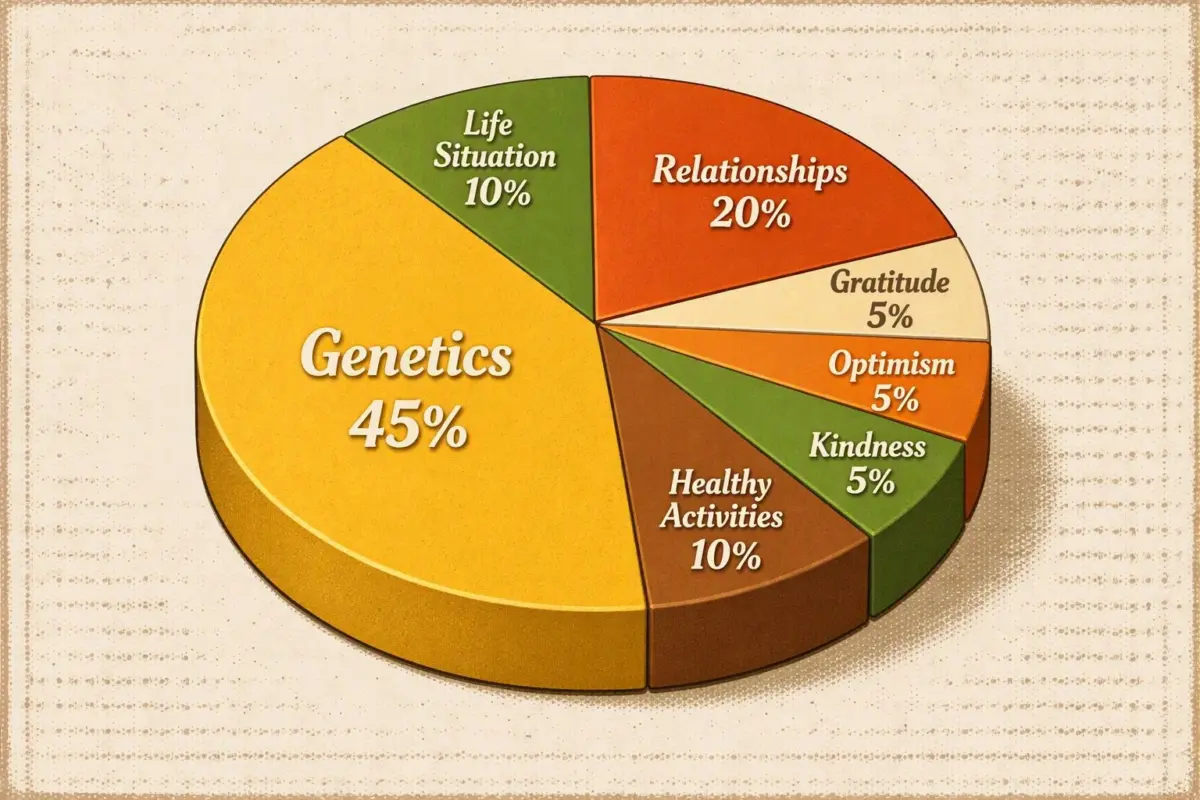
Standard of living, economic growth, and the viability of early retirement are fundamentally tied to high productivity. Beyond basic economic metrics, however, human happiness eventually tops out in the material dimension. Once a society surpasses minimum requirements for a comfortable standard of living, overall life satisfaction depends more heavily on personal choices, strong social relationships, lifelong optimism, and physical health than on incremental wealth accumulation.
Despite these reassuring historical lessons, many individuals remain consumed by fear. The root cause often lies in human evolution. Humans function largely as danger-detection machines, utilizing background anxiety as an evolutionary trait designed to protect against immediate physical threats. When physical survival is secured, the brain’s detection machinery does not simply turn off; instead, it looks for new sources of worry, constantly moving the goalposts. Once scarcity is managed, individuals worry about social exclusion, followed by financial positioning, neighborhood property standards, tax strategies, and even government-mandated retirement account distributions.

Combating this pervasive fear requires self-awareness and rational thinking. Understanding one’s personal history—such as growing up in households shaped by past economic depressions or scarcity mindsets—helps decouple historical trauma from present-day reality. By identifying specific fears and examining their actual worst-case scenarios, individuals can take concrete action. Taking action transforms the unfamiliar into the familiar, fostering resilience and confidence.
Another critical step in reducing anxiety involves curating one’s daily mental diet by minimizing exposure to sensationalized news media. Modern humans were biologically designed to solve problems actively using their bodies and minds, ideally outdoors. Spending excessive time in climate-controlled indoor environments consuming constant streams of curated crises naturally contributes to mental distress. Shifting focus toward active learning, physical movement, and building relationships with optimistic, productive peers creates a profound shift in mindset.

Applying this experimental framework to the current AI landscape reframes artificial intelligence from a looming threat into a fascinating technological evolution. Rather than succumbing to doom-scrolling, viewing AI as a sophisticated form of cognitive augmentation highlights its potential to boost efficiency and productivity. Much like the internet or the mobile revolution, technological advancements inevitably displace certain entry-level office and driving roles while simultaneously lowering service costs and catalyzing entirely new industries.
While the economic rewards of such innovations often concentrate heavily among business owners and equity shareholders—who frequently include everyday retail investors—Artificial Intelligence ultimately represents another opportunity for individual choice. Rather than defaulting to fear, viewing technological shifts as catalysts for learning and adaptation allows individuals to navigate an evolving world with confidence, keeping in mind that everything desired in life lies on the other side of fear.