
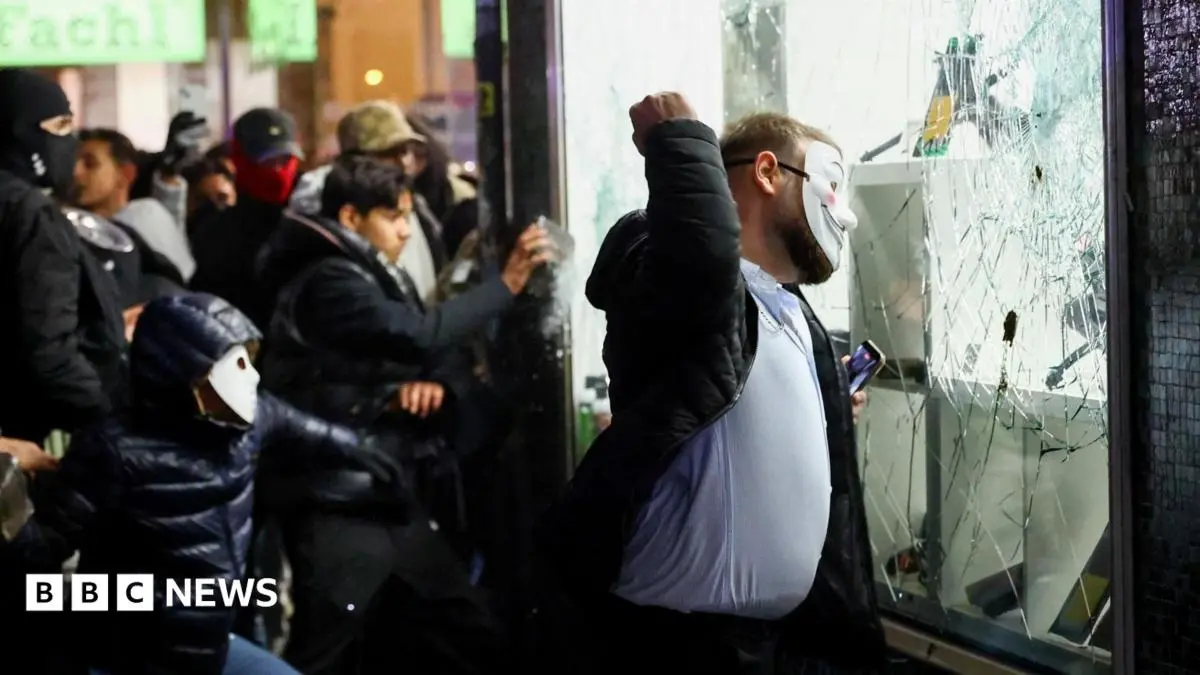
A wave of violent nighttime unrest swept through central Frankfurt and several other major German cities late on Saturday, following a day of widespread demonstrations over the rising cost of living, public spending cuts, and proposed military service. What began as a series of largely peaceful youth-led rallies across the country deteriorated into chaotic scenes after dark, as groups of rioters looted retail stores in Germany’s financial capital and clashed with security forces in key urban centers.
In Frankfurt, police were forced to seal off a large section of the city’s primary shopping street after groups of rioters targeted commercial establishments, smashing windows and looting shops. According to a spokesperson for the local police, officers made numerous arrests throughout the night as they moved to clear the streets and restore order to the commercial heart of the city. The central shopping district remained heavily guarded by law enforcement personnel long after the initial clashes erupted, with news agency reports confirming extensive cordons across major thoroughfares.
The violence in Frankfurt was matched by volatile confrontations in several other prominent German cities, including Berlin, Cologne, and Hamburg. Police authorities reported that emergency service personnel and law enforcement officers came under sustained attack from groups of violent demonstrators who launched fireworks, stones, and glass bottles. In response to the targeted attacks, police units deployed water cannons in multiple locations to disperse hostile crowds that had gathered in public squares and residential districts, seeking to reclaim control of the streets after hours of escalating hostility.
The night of chaotic disturbances stood in stark contrast to the earlier hours of the day, when thousands of citizens gathered for largely peaceful rallies organised across Germany. The nationwide day of action was spearheaded by a prominent youth campaign group known as "Gen Z regelt"—a phrase translating to "Gen Z takes charge." The organization mobilized young people across the country to voice opposition to what they characterize as severe underfunding in public education, the relentless strain of the high cost of living, ongoing cuts to public spending, and recent discussions surrounding the reintroduction of compulsory military service.
Throughout the afternoon, peaceful crowds filled designated protest routes, waving signs and chanting slogans aimed at drawing government attention to the economic and structural pressures facing the younger generation. Official estimates provided by municipal authorities in Frankfurt, Munich, and Berlin indicated that as many as 18,000 protesters had gathered across those three major cities combined. While significant, the official headcount represented roughly half of the attendance figure that organizers had originally anticipated and projected on their campaign website prior to the event. Nevertheless, German news media outlets reported that when accounting for regional gatherings across the entire federal republic, tens of thousands of individuals took to the streets over the course of the day.
The core message of the demonstrations was articulated by Gen Z regelt spokesperson Lina Friedrich, who outlined the primary motivations driving the youth-led movement. Speaking on behalf of the organization during the peaceful daylight demonstrations, Friedrich emphasized that the primary goal of the rallies was to advocate for systemic social investments rather than state-mandated obligations or geopolitical escalation.
Friedrich stated that the demonstrators had gathered "to fight for peace and freedom, rather than for war and coercion." Expanding on the specific policy demands of the campaign, she highlighted the urgent need for structural reform and increased financial resources for essential public infrastructure, particularly in sectors directly affecting youth and social well-being.
"What matters most to us is better support for the health and education systems," Friedrich said during her remarks. "We are against compulsory military service and we are in favour of a fairer distribution of the burden." Her comments reflected widespread concern among young Germans regarding fiscal austerity measures that have affected schools and social services, alongside growing apprehension over government policy directions concerning defense obligations and economic management.
The turbulent developments in Germany did not occur in isolation. Instead, they unfolded against the backdrop of a broader wave of coordinated youth-led mass protests that swept across the European continent on the very same day, underscoring growing transnational frustration over economic stagnation, inflation, and public service decay.
In France, more than 320,000 people took to the streets on Saturday, marking the third consecutive weekend of nationwide demonstrations demanding government intervention to address the soaring cost of living and the deterioration of essential public services, with a specific focus on underfunded educational institutions. The French rallies, which began as largely peaceful marches across dozens of cities, eventually escalated into widespread skirmishes between demonstrators and security forces as night fell.
French authorities deployed thousands of police officers nationwide to manage the massive crowds and secure government infrastructure. As tensions mounted in several urban centers, riot police fired tear gas to force back groups of demonstrators who refused to clear public roadways. Violent incidents were particularly pronounced in major regional cities such as Toulouse, Lyon, and Marseille, where sustained clashes between police units and violent splinter groups resulted in more than 500 arrests by the end of the evening.
In Paris, security conditions deteriorated rapidly as evening approached. Statements from the Paris police department confirmed that several hundred rioters launched aggressive attacks against security forces using a variety of makeshift weapons and heavy projectiles. The violence resulted in injuries among emergency responders, with French Interior Minister Laurent Nuñez confirming that a police officer was injured after being struck by a Molotov cocktail during the unrest in the capital.
Similar scenes of public discontent were recorded in Southern Europe, where economic pressures have hit young populations particularly hard. In Italy, widespread protests took place in major urban centers, with violent clashes reported between police units and groups of demonstrators in both Rome and Turin. Protesters in these Italian cities voiced anger over declining living standards, real wage stagnation, and reduced government investment in public infrastructure, leading to sharp confrontations with law enforcement officers attempting to maintain order along designated march routes.
In Portugal, the focus of public outrage centered on the country’s escalating housing crisis, which has seen real estate prices more than double over the past decade, placing adequate shelter out of reach for a vast segment of the youth demographic. Thousands of protesters marched through Portuguese streets to voice strong opposition to a controversial new rental bill that demonstrators argue will exacerbate housing unaffordability and drive up living costs even further. In the capital, Portuguese police intervened to forcefully clear a newly established tent encampment that had been assembled by activists seeking to maintain a prolonged occupation in protest of the legislation.
The unrest across Germany, France, Italy, and Portugal highlights a growing trend of youth-driven activism that has increasingly defined the political landscape across Europe in recent weeks. Mostly young demonstrators have taken to the streets in a broad swathe of European nations, including France, Belgium, Ireland, Spain, Portugal, Italy, Greece, Serbia, and Albania.
While the specific policy targets and local grievances vary from country to country—ranging from specific housing legislation in Portugal to educational spending and conscription debates in Germany—the underlying catalysts driving citizens into the streets remain strikingly consistent across national borders. Throughout the region, the protest movement has remained overwhelmingly centered on cost-of-living issues, fundamental access to affordable housing, the declining quality of state education systems, and broader opposition to government-mandated public spending cuts. As economic pressures continue to mount across the continent, the weekend’s widespread events demonstrate the expanding reach and intense friction surrounding youth-led mobilization in contemporary Europe.