
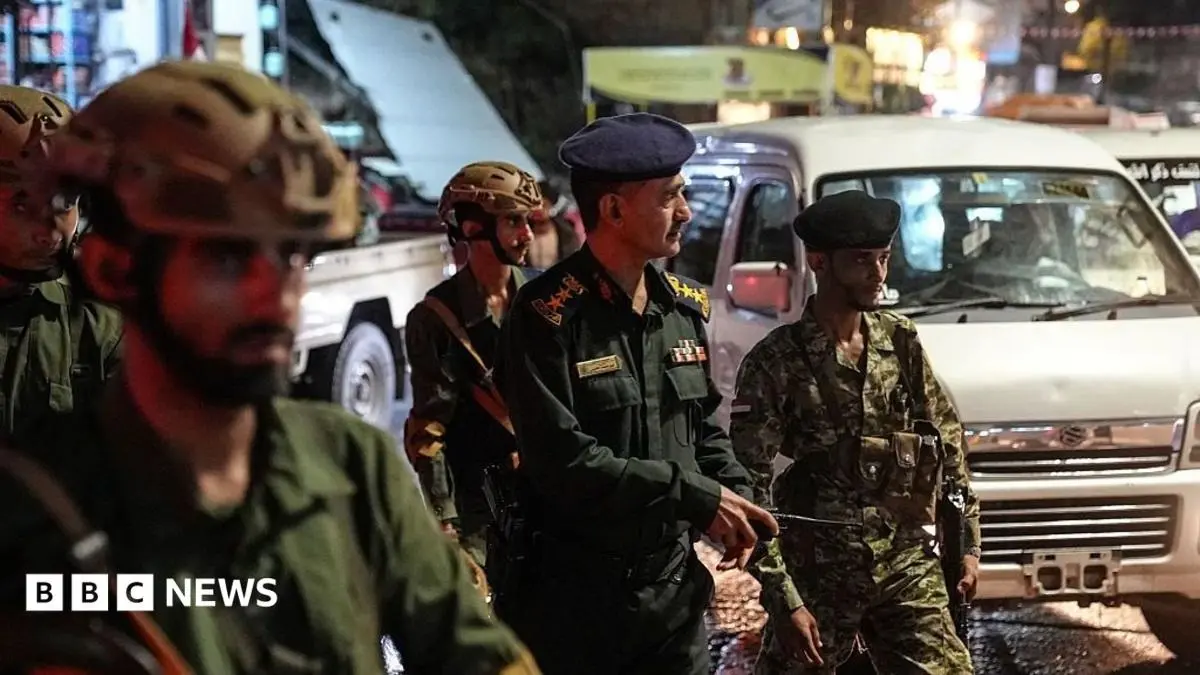
A devastating ballistic missile strike launched by Houthi forces on a military and police training camp in Yemen’s central province of Shabwa on Monday has left at least 73 security personnel dead and dozens more wounded or missing, according to updated assessments from local government authorities.
The strike targeted the al-Alam camp near the provincial capital of Ataq, where three ballistic missiles struck the Martyr Ahmed al-Sulaimani Training Centre. The installation was being utilized as an active instruction facility for new recruits preparing to join internal security forces and police units across several Yemeni provinces. Military officials aligned with the Saudi-backed Yemeni government confirmed the attack, which represents the single deadliest incident reported since conflict escalated sharply across multiple front lines in recent months.
The immediate aftermath of the bombardment plunged local medical facilities into severe distress. Initial casualty reports released on Monday by the Shabwa province media office indicated that 53 people had been killed and approximately 200 others injured. However, as search teams worked through the debris and an official inquiry was launched, the verified casualty count rose significantly.
On Tuesday, the provincial media office issued a revised statement confirming that Shabwa Governor Awad bin al-Wazir had received a detailed report from a dedicated investigative committee. The committee reported that the death toll had climbed to 73, while at least 14 additional individuals remained unaccounted for amidst the rubble of the facility.
The overwhelming volume of casualties completely stretched the capacity of local healthcare infrastructure in Shabwa. Medical staff across the province were forced to render emergency aid under severe resource constraints, prompting authorities to organize critical medical evacuations. Shabwa’s Deputy Governor, Fahad al-Khalifi, told the AFP news agency that local hospitals were inundated by the sheer number of victims, necessitating the transfer of the most critically injured patients to hospitals in neighboring Hadramout province, as well as to the southern port city of Aden, where the internationally recognized Yemeni government is currently based.
Visual evidence from the scene highlighted the chaotic and violent nature of the attack. Video footage circulated across social media platforms appeared to show numerous casualties scattered across the open grounds of the facility, illustrating the intense destruction inflicted on the training camp.
The assault triggered swift and bitter condemnations from high-ranking government officials. Rashad al-Alimi, head of Yemen’s Presidential Leadership Council, issued a public statement strongly denouncing what he termed a "criminal attack" against defenseless recruits. Al-Alimi offered condolences to the families of the victims while promising that the government and its security forces would deliver a "firm response" to the Houthi movement.
Yemen’s Information Minister, Moammar al-Eryani, categorized the missile attack as a blunt war crime, maintaining that the Martyr Ahmed al-Sulaimani Training Centre was dedicated strictly to internal security and policing functions rather than frontline military operations. Minister al-Eryani publicly accused the Houthi leadership of attempting to manufacture a narrative of success to distract from recent losses elsewhere in the country. He alleged that the Iran-backed movement was "attempting to fabricate a false media victory, boost the morale of its collapsing elements, and cover up the defeats and setbacks it is suffering across various combat axes."
A conflicting narrative was presented by the military leadership of the Houthi movement. Speaking via official Houthi media channels, the group’s military spokesman, Yahya Sarea, acknowledged that Houthi forces had carried out the missile strike on the al-Alam camp. Sarea disputed the government’s characterization of the facility as an internal security facility, asserting instead that the missiles were fired at a major concentration of "Saudi enemy" forces. Sarea claimed that the al-Alam camp was managed and operated directly by Saudi military officers.
Saudi authorities offered no immediate public comment regarding the Houthi claims or the casualties sustained at the Shabwa installation.
The attack on the Shabwa facility comes against the backdrop of a major flare-up in Yemen’s long-running civil war, which has seen heavy fighting resume across multiple strategic regions after months of relative lull. At the beginning of October, pro-government armed forces launched a major military offensive aimed at regaining territory controlled by the Houthis in western Yemen.
With substantial air support provided by a Saudi-led coalition of Arab states, government forces succeeded in retaking key coastal areas along the Red Sea. These coastal territories hold immense strategic value, as they directly overlook the Bab al-Mandab Strait, a crucial maritime transit point for global commerce and energy shipments. The Houthis had previously seized control of these Red Sea positions during a surprise offensive in September before being pushed back by the government’s October counter-offensive.
Despite the territorial shifts along the coast, heavy fighting has continued unabated in several other regions. Fierce clashes persist near the Red Sea coastline as well as around the besieged, government-controlled city of Taiz, which has endured years of tactical blockades. To the north, heavy combat continues to rage across the strategic and energy-rich provinces of Marib and al-Jawf, where opposing forces remain locked in intense battles.
As ground operations inside Yemen expanded, the Houthis intensified their long-range strike campaign against neighboring Saudi Arabia in response to coalition air strikes. The Iran-backed group has repeatedly deployed ballistic missiles and attack drones targeting civilian and military infrastructure across the kingdom, focusing heavily on regional and international airports, key energy facilities, and strategic military bases.
This cross-border air campaign has resulted in substantial fatalities within Saudi Arabia. Since the start of October, at least 19 people have been killed in Houthi missile and drone strikes specifically targeting airport facilities inside the kingdom.
Concurrently, aerial bombardment by the Saudi-led coalition within Houthi-controlled territory has inflicted heavy casualties on local populations. In a separate incident reported by Houthi-aligned media outlets, a Saudi air strike struck a residential house in the Sahar district of the northern province of Saada—a traditional Houthi stronghold—on Sunday. Houthi media reported that the strike killed at least 10 people and injured 23 others, noting that a significant proportion of the victims were women and children.
Statistical data published by health officials on both sides of the conflict underscores the staggering scale of life lost during the recent surge in violence. The Houthi-run health ministry operating out of north-western Yemen reported that Saudi air strikes have killed a total of 141 people across its territories over the past seven weeks. Meanwhile, the official health ministry associated with the recognized Yemeni government stated last week that at least 1,282 people had been killed in conflict-related violence across various parts of Yemen since August 6.
Yemen’s broader civil war first erupted in 2014 when Houthi forces advanced from their northern strongholds and overran the capital, Sanaa, ousting the government from power. The conflict dramatically expanded into a regional war in 2015 following the military intervention of the Saudi-led coalition, which sought to restore the internationally recognized government to authority.
A four-year-old informal ceasefire that had managed to keep major combat operations contained began to fall apart rapidly in July. The breakdown occurred after the Houthis officially declared a "maritime embargo" against Saudi Arabia and resumed direct missile and drone attacks aimed at Saudi airports, oil processing facilities, and commercial oil tankers operating in the Red Sea.
Houthi officials defended their renewed offensive actions by citing the ongoing economic and naval blockade maintained by Saudi Arabia over Houthi-controlled areas. The movement also pointed to a specific coalition air strike on the Sanaa international airport, which they blamed on the kingdom, as a direct justification for launching retaliatory strikes across the border and into key shipping routes.
The strike in Shabwa highlights the complete disintegration of that fragile informal truce, dragging the nation back into multi-front military combat. With government forces continuing their offensive push in western Yemen and Houthi forces carrying out high-casualty missile operations, the conflict shows few signs of abating as the humanitarian burden on the population continues to grow.