

The call came from a home in Hyde County, a vast, rural expanse of coastal farmland and marshlands in North Carolina characterized by challenging terrain and isolated properties. Paramedic Quinn Reece did not jump into a traditional ground ambulance or even a conventional helicopter. Instead, she climbed into an electric aircraft featuring a single seat, two wings, and eight propellers.
Known as the BlackFly and measuring about 14 feet long, the compact machine bears a striking resemblance to an oversized drone. Moments after Reece secured herself inside, the aircraft rose vertically like a helicopter before transitioning into forward flight, soaring like an airplane.
As she raced toward the reported emergency at an approximate speed of 60 miles per hour, a dispatcher described the location over the communication channels. Reece quickly realized that the digital mapping application used by the county for emergency response had provided an incorrect address. Because she had previously flown over the area during training exercises, Reece retained a mental map of the local landscape and deduced the correct destination. She zipped over in the aircraft, pinpointed the exact residence from which the call had originated, and relayed the accurate coordinates to ground paramedics heading toward the scene. Thanks to her aerial vantage point and rapid transit, Reece was on the scene and actively administering medical care a full 20 minutes before the ground ambulance arrived.
This is precisely the operational outcome that Brook Cox, the county’s emergency medical services chief, had hoped to witness when she initiated a six-month trial with the aviation company Pivotal in March. Cox launched the pilot program to evaluate whether the BlackFly could help emergency medical personnel reach patients more rapidly across a sprawling jurisdiction that covers 1,459 square miles of mixed land and water. Before deploying the aircraft to respond to live 911 calls, the county conducted more than 300 rigorous training flights to ensure safety and operational familiarity.
For years, air taxis and flying cars have dominated the public imagination regarding the potential of electric vertical takeoff and landing aircraft, commonly known as eVTOLs. This futuristic vision has been heavily highlighted by the Federal Aviation Administration through its eVTOL Integration Pilot Program, a federal initiative that collaborates with private manufacturers to test emerging aircraft designs in real-world operational settings. Recent industry milestones underscore this broader momentum; Archer Aviation announced plans to roll out commercial aerial taxi services across three major Texas cities, while Joby Aviation recently initiated live flight demonstrations in Florida.
However, Hyde County and other forward-thinking municipalities are exploring much more immediate, utilitarian roles for these innovative machines. The FAA program considers emergency medical response to be a vital application for eVTOL technology, particularly in rural and geographically isolated areas where conventional response times lag behind national standards. Concurrently, similar electric aircraft powered by solar energy—capable of remaining aloft for weeks at a time—are being developed to monitor escalating climate threats, including wildfires, methane leaks, and polar ice melt.
The overarching promise of electric aviation has always been centered on helping decarbonize flight and reducing the carbon footprint of the transportation sector. These ongoing developments point to a fast-approaching future where electric aviation becomes a daily reality, even if it arrives in a specialized utility format rather than the mass passenger air taxis many originally expected.
Kristina Menton, Pivotal’s vice president of flight, points to a successful flight demonstration in December 2024 as concrete proof that the technology could serve as a powerful boon to emergency medical services. During that test, a BlackFly took off directly from a Los Angeles County fire station and landed safely in a private residential backyard in Malibu, successfully demonstrating its ability to navigate urban and suburban environments and deliver a responder directly to a private address.
Menton acknowledged that single-seater specialized aircraft represent a novel approach for an emergency response industry that has historically relied on distinct, separate crews for flight operations and medical care. The BlackFly’s simplified control interface allows a single trained professional to function as both pilot and medical responder simultaneously.
"The aircraft is a breeze," Cox said of the intuitive control system. "It really takes the guesswork out of it because you have a screen and you have all these prompts that you have to go through."
Carl Dietrich, who founded Jump Aero in 2019 specifically to engineer electric aircraft for emergency medical applications, views Pivotal’s pioneering work as a valuable proof of concept rather than direct market competition. He believes these milestones will help the entire advanced air mobility sector grow.
"It shows that other organizations believe that this is a real opportunity," Dietrich noted.
Jump Aero is currently developing a distinct type of specialized emergency response aircraft known as the JA1 Pulse, a project that has been in development for seven years. Dietrich projects that the Pulse will achieve top speeds of 288 miles per hour, significantly faster than the 63-mile-per-hour cruising speed of the BlackFly. He emphasized that these new eVTOLs are not necessarily intended to replace traditional helicopters or ground ambulances, but rather to introduce an entirely new capability to emergency response protocols: an aircraft that is exceptionally simple to fly and capable of launching almost instantaneously without the lengthy warm-up procedures required by turbine-powered helicopters.
"It’s ideal for rapid response missions because you don’t pay any maintenance penalty for going to full power instantly," Dietrich explained.
This immediate readiness is particularly critical in an emergency medical field that strives for an ideal response time of eight minutes from the initial call, whereas rural response times across the United States currently average nearly 15 minutes.
Naturally, these innovative aircraft come with certain engineering limitations, most notably concerning battery range and weight capacity. The BlackFly has a travel range of approximately 20 miles on a single battery charge and can carry a payload of 200 pounds, while the larger JA1 Pulse is engineered for a 70-mile range and a 350-pound payload capacity.
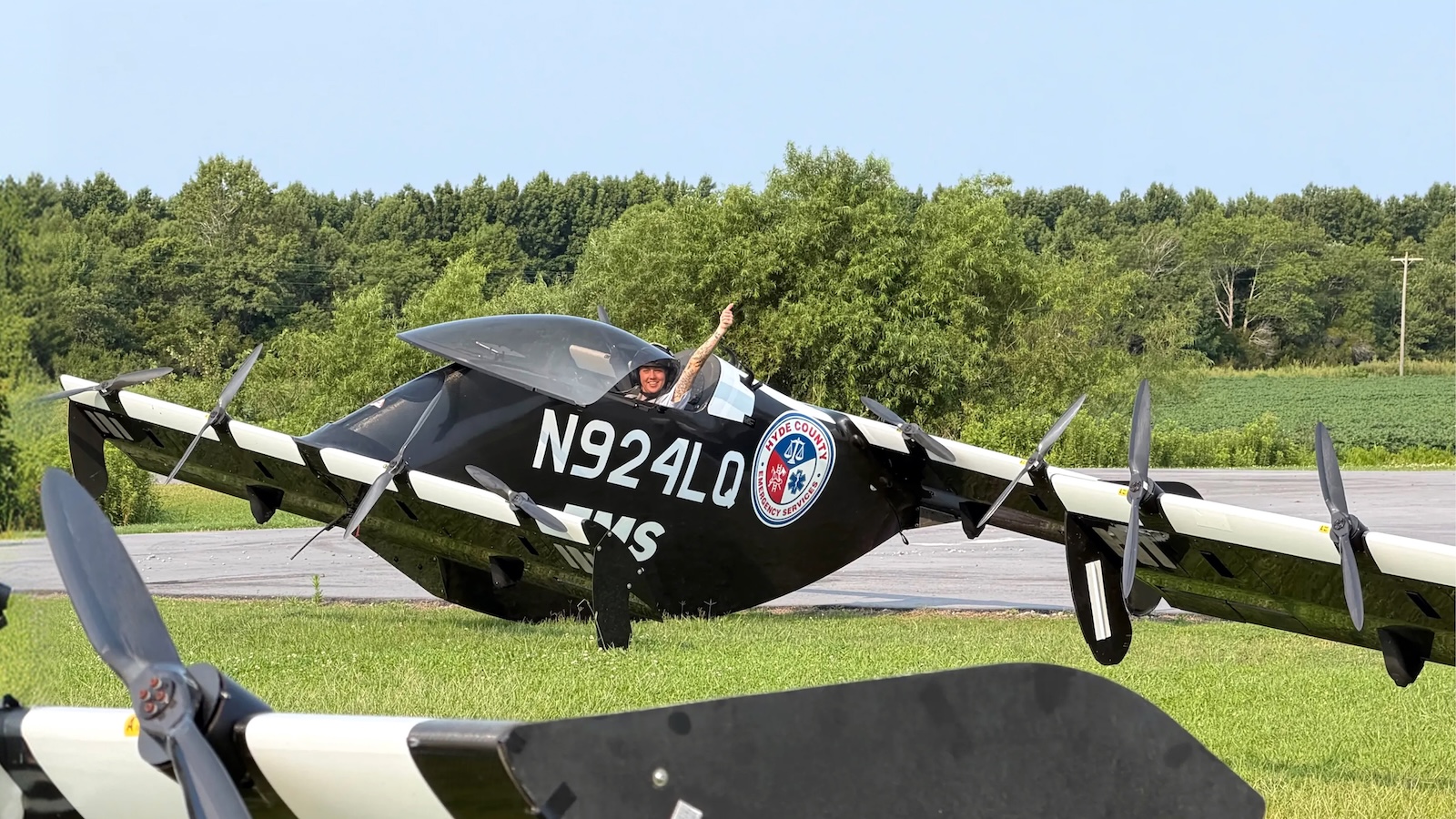
Because of these constraints, the aircraft are explicitly not designed to transport patients to hospitals. Instead, their true utility lies in their ability to bridge the time gap, rapidly reaching an isolated emergency scene to assess and stabilize a patient until ground transport arrives. During her flight in Hyde County, paramedic Reece carried a portable cardiac monitor, critical airway management supplies, and a specialized primary response bag containing essential medical gear, enabling her to begin immediate patient assessment and treatment long before other medical personnel could physically arrive.
Rural environments may ultimately provide a much smoother regulatory and logistical path for introducing this technology into public service, according to April Zhang, director of advanced air mobility at the University of South Florida’s Center for Urban Transportation Research.
"In the urban area, it’s probably more challenging to find the right landing and takeoff sites," Zhang said, noting that population density and airspace congestion present unique hurdles. Menton added that municipal leaders from other counties are already closely monitoring Hyde County’s operational trial and actively considering launching similar emergency aviation programs of their own.
Zhang emphasizes that the FAA’s eVTOL Integration Pilot Program serves as a vital bridge for manufacturers and public agencies to collaborate on practical applications. Beyond emergency medical response, she identifies traffic surveillance and specialized cargo delivery as other promising commercial and municipal use cases.
Furthermore, existing Federal Aviation Administration policies may offer public agencies a more streamlined pathway to adopting eVTOL technology compared to commercial operators. Andrew Mearns, a commercialization consultant at Multicopter Aerospace Consulting, pointed out that emergency medical services organizations can frequently operate under the FAA’s established public aircraft rules. This regulatory framework can potentially allow public responders to fly without securing the extensive commercial pilot credentials otherwise mandated for commercial air taxi operations.
Cost represents another powerful incentive for cash-strapped municipal and rural departments. Pivotal’s commercial model retails for approximately $190,000, whereas Mearns noted that traditional utility helicopters can range anywhere from $500,000 to as much as $10 million to purchase. While ongoing operational costs will vary depending on the specific model and maintenance schedule, industry experts suggest that operating an electric aircraft can be roughly 80 percent cheaper than maintaining and fueling a similarly sized fossil-fuel-burning machine.
Emergency medical response is just one avenue where electric aviation is beginning to find practical, real-world utility. Another specialized domain is taking shape much higher in the Earth’s atmosphere.
Unmanned stratospheric aircraft are now capable of reaching altitudes of up to 65,000 feet, flying roughly twice as high as commercial airliners. Advanced solar-powered versions can remain continuously aloft for weeks or even months at a time, rendering them ideally suited for long-term environmental monitoring and disaster management.
"If you imagine these solar-powered aircraft just circling the L.A. County area, collecting soil moisture, vegetation moisture data, with complex math models and deep learning mapped to that, you can have improved risk profiles better than the models that are currently there," said Craig Mascarenhas, an aerospace researcher at Harvard University.
Mascarenhas noted that such high-altitude aircraft could also spot emerging wildfires much more quickly and transmit precise mapping data to assist first responders on the ground. He leads engineering research for Harvard’s branch of the Stratospheric Airborne Climate Observing System, where he collaborates with Electra.Aero, MIT, and other academic and industry partners to develop and deploy solar-powered electric aircraft. He emphasized that the potential applications extend far beyond wildfire detection.
"It’s hurricane monitoring and tracking, methane emission monitoring, understanding ice dynamics across the world," Mascarenhas said. "The instruments will be swapped, but the topology of the aircraft will remain the same."
The aircraft themselves can also offer tangible environmental benefits, though experts note the calculus depends heavily on what systems they replace. Mascarenhas explained that eVTOLs can significantly reduce greenhouse gas emissions when deployed to replace conventional fuel-burning helicopters, though the climate advantages are less clear-cut when they are compared against highly efficient ground transportation networks.
"Vertical flight is inherently energy-intensive, and an electric aircraft is not necessarily more energy-efficient or lower-carbon per passenger-mile than an electric car, bus, or train," he cautioned.
For Pivotal, the successful deployment of the BlackFly in Hyde County’s emergency medical services is viewed as only the beginning. Menton stated that the company’s broader long-term vision is to revolutionize regional transportation by making short-distance electric flights safely accessible to a much broader segment of the population.
For now, however, some of the technology’s most immediate and impactful uses are taking root through specialized applications being rigorously tested in remote rural communities like Hyde County, and high above the clouds in the Earth’s stratosphere.