
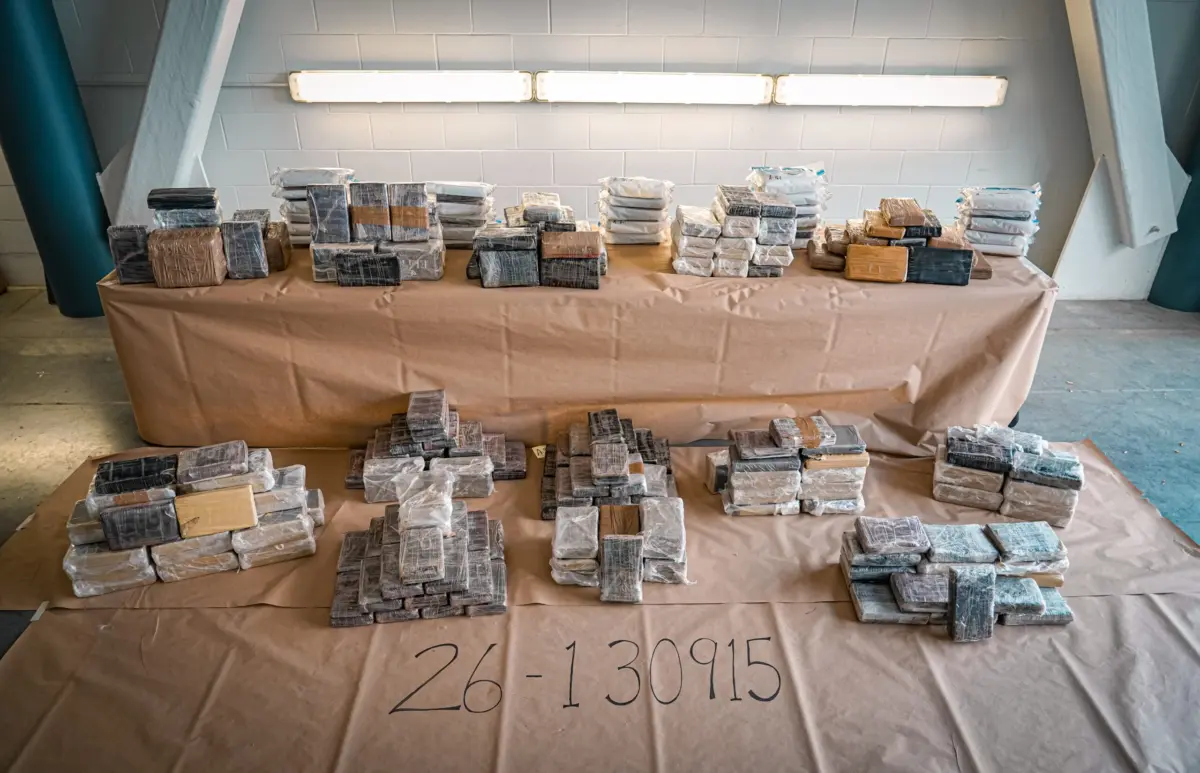
The quiet commercial routine of a Vancouver-based import business was abruptly shattered when employees unpacking a bulk order of t-shirts discovered that their inventory had been replaced with millions of dollars worth of illicit narcotics. What appeared to be a standard shipment of retail apparel turned out to hide the largest single cocaine seizure in the history of the Vancouver Police Department, triggering a massive, multi-jurisdictional investigation that spans several countries and oceans.
The Vancouver Police Department (VPD) announced the historic bust on Tuesday, revealing that officers had seized a staggering 328.55 kilograms of high-purity cocaine. With an estimated street value of approximately $5.8 million, the sheer scale of the haul marks an unprecedented milestone for the municipal police force. Investigators revealed that the drugs had been meticulously concealed within a legitimate commercial shipping container that had traveled thousands of miles through major international transit hubs before arriving at its final, unintended destination in British Columbia.
According to police, the discovery was made on July 21 when staff members at the unsuspecting Vancouver company were systematically sorting through newly arrived boxes of t-shirts. Expecting to find retail merchandise, the employees instead pulled out heavy, tightly wrapped packages of contraband. Recognizing the gravity of the situation, the workers immediately halted their operations and contacted law enforcement. Officers arrived at the business shortly after and took possession of the massive cache of narcotics.

In an official statement addressing the extraordinary find, Sgt. Travis Fraser of the Vancouver Police Department emphasized the complete innocence of the business and its staff. "Obviously, the business was shocked by what it found," Sgt. Fraser said. "They called police right away and are in no way associated with the seized cocaine."
The swift and cooperative response from the company’s employees prevented the multi-million-dollar cargo from being reclaimed by the criminal elements that organized its transit, while also providing law enforcement with an intact, highly valuable chain of physical evidence.
Law enforcement experts note that the circumstances of the seizure point directly to a sophisticated, albeit failed, smuggling technique known in international drug enforcement circles as the "rip-on, rip-off" or "blind hook" method. Under this scheme, transnational organized crime syndicates piggyback on legitimate global commerce. Rather than establishing their own shipping routes or utilizing suspicious front companies—which are highly vulnerable to customs screening—traffickers target reputable, high-volume commercial importers with established, clean compliance records.
By utilizing corrupt insiders at foreign ports of origin, smugglers breach the security seals of a container destined for an innocent company. They pack their contraband alongside the legitimate cargo, such as bulk clothing, and then reseal the container using cloned or counterfeit high-security seals to avoid raising red flags during transit. The critical phase of the operation occurs when local operatives of the criminal network intercept the container at a transit terminal, a rail yard, or a temporary holding facility before it reaches its final destination. These local conspirators cut the seals, retrieve the hidden narcotics, and quickly reseal the container, leaving the legitimate cargo to be delivered to the unsuspecting business without anyone ever realizing the shipment had been compromised.

In this instance, however, the criminal syndicate’s logistics network suffered a critical failure. "We believe the cocaine was supposed to be removed prior to its arrival at the company," Sgt. Fraser explained. "For some reason, it was not unloaded." Whether due to heightened security at regional rail yards, a breakdown in communication among local gang members, or unexpected changes in delivery schedules, the retrieval crew was unable to access the container. As a result, the shipping container was loaded onto a delivery truck and transported directly to the Vancouver warehouse, delivering a devastating financial blow to the organized crime group responsible.
Investigators have successfully mapped out the extensive, multi-month timeline of the shipping container’s journey, illustrating the immense challenges of monitoring global maritime supply chains. The journey began on May 18, when the container was loaded onto a vessel and departed from Honduras. Honduras has long been identified by international drug enforcement agencies as a key transit corridor for narcotics moving from South American production regions toward North American markets.
From Central America, the vessel traveled to the Caribbean, making a scheduled stop in Jamaica on June 6. Jamaica’s busy deepwater ports serve as a primary transshipment hub, connecting major shipping lanes from South and Central America to ports across eastern North America and Europe. After departing Jamaica, the cargo ship continued its northward voyage, eventually arriving at the Port of Montreal on July 5.
As one of Canada’s largest and busiest marine gateways, the Port of Montreal handles millions of containers annually. Once the container cleared the initial port facilities in Quebec, it was transferred to a rail line for the long overland transit across Canada, ultimately arriving at the commercial facility in Vancouver where the drugs were uncovered on July 21.

The sheer volume of the seized narcotics, combined with the professional manner in which they were prepared, leaves no doubt among investigators that a highly organized, transnational criminal network orchestrated the shipment. Sgt. Fraser noted that the physical characteristics of the seized cocaine bricks provided immediate clues regarding their origin. "This amount of drugs, as well as the stamps and packaging, clearly indicates organized crime is behind the shipment," Fraser stated.
In the global illicit drug trade, cartels and large-scale distribution syndicates utilize distinct branding to identify and track their inventory. Pressed cocaine bricks are typically wrapped in multiple layers of heavy-duty waterproof packaging, often sealed with wax, plastic, or rubber to protect the chemical integrity of the drug from moisture during long maritime voyages. Furthermore, these bricks are almost always marked with unique embossed stamps, logos, or symbols. These markings act as trademarks within the criminal underworld, indicating which specific cartel or manufacturing laboratory produced the narcotics, signifying the purity level of the batch, and helping distribution coordinators keep track of ownership as the shipment is divided among various regional gang networks. The presence of these professional markings on the 328.55 kilograms of cocaine confirms that the shipment was destined for a highly structured distribution network capable of managing multi-million-dollar wholesale transactions.
Because the smuggling route crossed several international borders and involved multiple transit hubs, the Vancouver Police Department is not working in isolation. The investigation has rapidly evolved into a complex, multi-jurisdictional effort. VPD detectives are actively collaborating with a network of domestic and international law enforcement agencies to trace the origins of the shipment and identify the individuals responsible for its dispatch and attempted retrieval.
Within Canada, the VPD is working closely with federal partners, including the Canada Border Services Agency (CBSA) and the Royal Canadian Mounted Police (RCMP). Investigators are analyzing shipping manifests, customs declarations, and digital security logs associated with the container to identify any anomalies or suspicious modifications made to the documentation during transit. Internationally, the VPD is cooperating with law enforcement and border authorities in Honduras, Jamaica, and the United States. Agencies such as the U.S. Drug Enforcement Administration (DEA) and Homeland Security Investigations (HSI) maintain extensive databases on container security breaches and cartel logistics, which could provide vital intelligence in identifying the transnational actors behind the shipment.

The international aspect of the investigation will focus heavily on identifying where the physical security of the container was compromised. Investigators are reviewing port security footage, employee logs, and communication data from the ports of departure in Honduras, the transit docks in Jamaica, and the arrival terminals in Montreal. Pinpointing exactly when and where the cocaine was loaded—and where the failed retrieval was supposed to take place—is crucial to dismantling the network responsible.
A seizure of this magnitude represents a significant disruption to the local and national illicit drug market. While British Columbia’s Lower Mainland has long struggled with the presence of organized crime and drug trafficking, a single municipal seizure of over 300 kilograms of cocaine is incredibly rare. The removal of $5.8 million worth of cocaine from the supply chain deprives criminal organizations of massive profits that would otherwise be used to finance further illicit activities, purchase illegal firearms, and fuel gang-related violence in local communities.
Despite the historic nature of the bust, no suspect information has been released by the Vancouver Police Department at this time. The investigation remains highly active and sensitive, as authorities work to identify both the international orchestrators of the shipment and the local individuals who were tasked with retrieving the contraband. The VPD has issued a public appeal, urging anyone with information regarding this shipment, suspicious activity around shipping containers, or the individuals involved in the logistics chain to contact police.