

The value of the S&P 500 index has climbed roughly 57 percent over the past two years, more than doubling over the past five. For many investors who rely on index funds for their retirement savings, this rapid ascent has significantly altered net worth calculations. Individuals who felt they were only halfway to their financial independence goals during the pandemic era may suddenly find themselves crossing the finish line, while long-term retirees are confronting a market environment where portfolios are expanding at an unprecedented pace.
This surge has inevitably sparked a familiar debate across financial circles: is the current market reality built on solid economic fundamentals, or is it a speculative bubble driven by technological euphoria?

The underlying question facing everyday savers is whether the intense market enthusiasm surrounding artificial intelligence leaves portfolios vulnerable to a severe correction, and how those potential shifts might impact long-term retirement security. To understand the current financial landscape, it is helpful to return to the fundamental mechanics of what a stock represents.
At its core, owning a stock is a business arrangement functionally identical to owning a rental property. When an investor purchases a rental house, they are entitled to a steady stream of rental income. After covering operating expenses, the remainder constitutes profit. If local property values appreciate while tenant rents remain unchanged, the higher valuation looks favorable on paper, but it yields no additional cash flow unless the property is sold. To increase financial returns, a landlord must enhance profitability by raising rents, executing renovations, or streamlining expenses. When that property is eventually sold, the price a new investor is willing to pay should be tied directly to that future income stream.

Applying this logic to the stock market reveals a distinct valuation disconnect. An investment of $100,000 made in the broad market in 2019, with dividends reinvested, would be worth roughly $256,960 today, representing a 157 percent gain. However, over that same timeframe, the underlying share of company earnings generated by that basket of stocks has grown from $5,290 to $7,540, an increase of about 42 percent. Consequently, the price-to-earnings, or P/E, ratio has expanded from approximately 20 to around 30.
Just like rental property investors facing doubled home prices while rents inch upward, contemporary stock investors are purchasing assets at higher valuation multiples. Basic math dictates that buying at elevated P/E ratios results in lower future income yields relative to portfolio size compared to purchasing assets when they are more reasonably priced. While owning stocks remains a viable long-term strategy, investors must calibrate their expectations for future returns accordingly.

A critical nuance in valuation involves anticipated earnings growth. If a real estate investor purchases an overpriced property near a newly planned corporate campus, they might justify the higher purchase price by anticipating rapid rental growth. Similarly, individual stock prices rise when corporate prospects brighten, as seen during the pandemic-era boom in home exercise equipment before demand normalized.
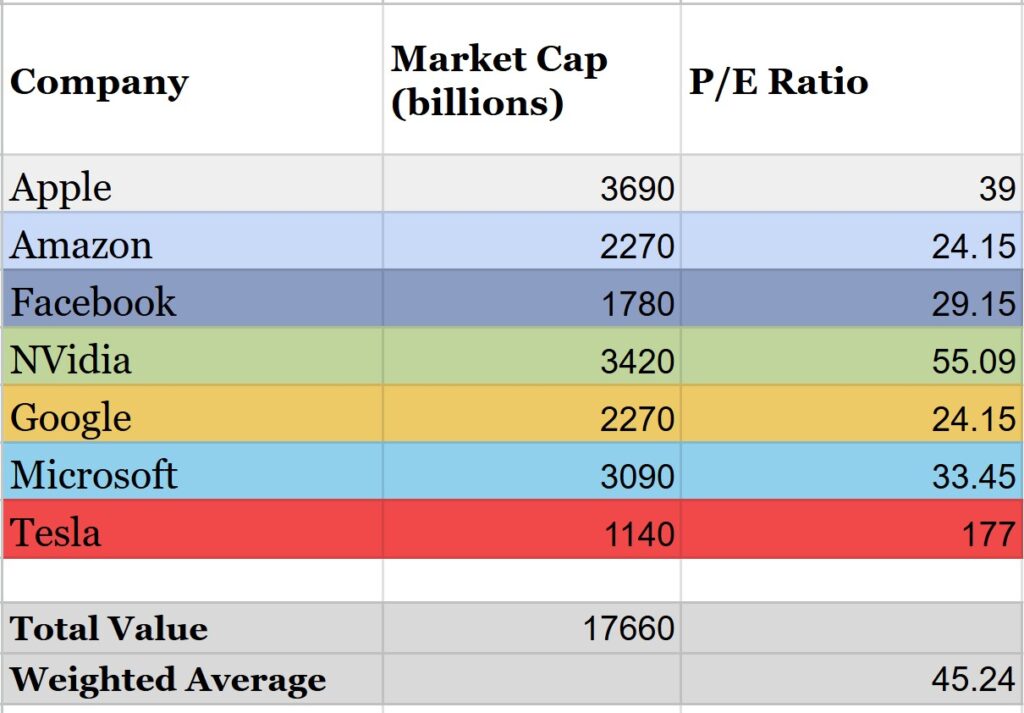
However, when the entire market climbs to historic valuation highs, it signals a broader economic expectation or a concentration of extreme growth in specific sectors. A closer examination of the S&P 500 reveals that approximately three-quarters of recent market gains have been driven by just seven major technology firms: Apple, Nvidia, Microsoft, Amazon, Alphabet, Meta, and Tesla.
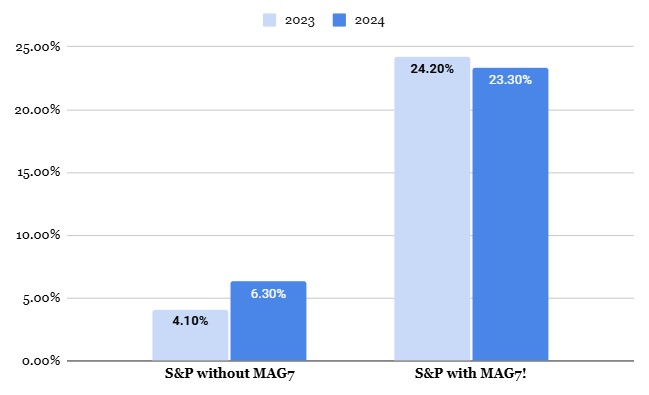
Often referred to as the Magnificent Seven, these highly profitable technology companies account for more than 25 percent of the total market capitalization, representing roughly $17.66 trillion. Their collective P/E ratio sits at a weighted average of about 45. In contrast, excluding these seven giants leaves the remaining 493 companies in the index trading at a more modest P/E ratio of roughly 20. This stark divergence indicates that while the broader economy is projected to experience steady growth, market participants are pricing in extraordinarily rapid expansion for the tech sector specifically.
The catalyst behind this technology-driven concentration is the rapid advancement of artificial intelligence. Recent breakthroughs have demonstrated software capable of executing complex, human-like reasoning across various professional fields, igniting a wave of corporate investment. Six of the largest technology firms are channeling hundreds of billions of dollars into constructing massive infrastructure projects featuring specialized supercomputers. Meanwhile, hardware providers like Nvidia are experiencing unprecedented demand, allowing them to command premium pricing for their components.
Proponents of the AI boom argue that the economy is entering an era of unprecedented productivity. Businesses are already utilizing advanced systems to parse extensive legal documents, identify software vulnerabilities, diagnose medical conditions from imagery, optimize pharmaceutical research, and develop autonomous physical labor solutions. The underlying investment thesis posits that society is on the threshold of integrating an expansive, highly intelligent digital workforce capable of bypassing traditional human constraints on labor and intelligence.
While technological adoption appears likely to alter industries profoundly, the central question for investors is whether corporate profits will ultimately materialize to justify these lofty valuations, or whether unforeseen challenges such as escalating costs, regulatory hurdles, or market competition will intervene.

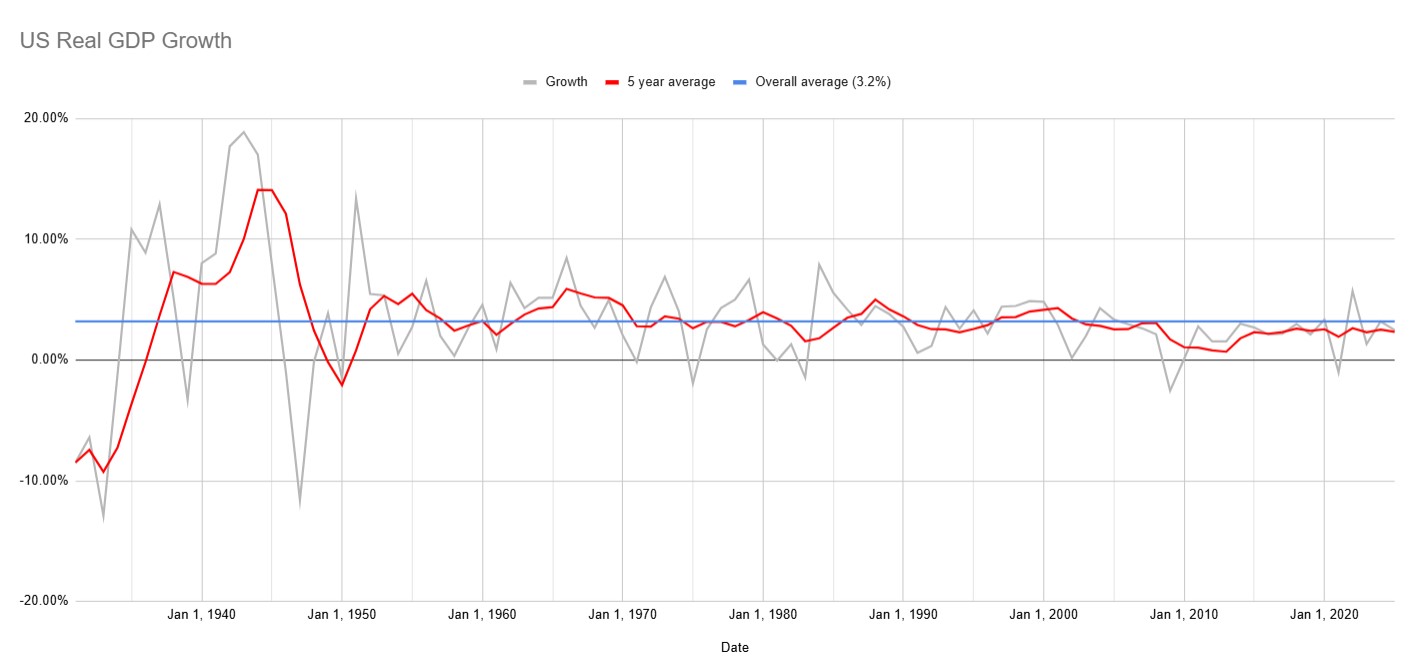
Historically, long-term United States economic growth has averaged a relatively steady three percent annually after accounting for inflation. Interestingly, recent decades have actually recorded slightly slower growth than the historical average, making current equity valuations a point of discussion among conservative financial analysts.
Institutional forecasters are also weighing these dynamics. Projections released by Vanguard suggest that international equities and fixed-income assets may outperform domestic stocks over the coming decade. International benchmarks, such as broad European indices, currently trade at significantly lower P/E ratios, hovering near 16, which marks a substantial valuation discount compared to United States markets. Nevertheless, domestic markets have continued to outpace international alternatives, largely driven by the concentration of artificial intelligence development stateside.
Other prominent market observers share a cautious outlook on current valuations. Berkshire Hathaway has maintained a substantial cash reserve of over $300 billion, signaling a scarcity of attractively priced acquisition targets and a reluctance to repurchase its own shares at prevailing market multiples. Similarly, questions surrounding debt management have reemerged; while maintaining a mortgage while investing surplus cash in equities has historically favored long-term growth, rising interest rates have narrowed the gap, prompting some homeowners to prioritize guaranteed debt reduction.
Despite ongoing debates regarding market valuations, economic cycles, and technological disruption, core financial principles remain consistent. Trying to time market corrections or volatility historically proves counterproductive for long-term savers. Even if equity valuations eventually moderate toward historical averages, continuous corporate earnings growth suggests that patient, diversified investing will remain a viable path for building long-term wealth, allowing individuals to focus their time and energy on personal pursuits outside of daily financial news cycles.